Health and Safety Policy for Flat Clearance Stoke Newington
This Health and Safety policy sets out the commitment of our flat clearance and rubbish removal operations to protect employees, clients, contractors and members of the public while delivering safe, reliable waste and clearance services in our service area. Our flat clearance Stoke Newington approach is risk-focused and aligns with widely accepted industry practice for rubbish company and clearance activities. This document explains responsibilities, control measures and procedures designed to reduce harm from manual handling, vehicle operations, hazardous items and environmental risks. It is intended as a legal-style policy statement rather than an operational guide.
Scope and Responsibilities
This policy applies to all personnel engaged in flat clearances, rubbish collection, bulky item removals and associated logistical activities across our rubbish company service area. The organisation's senior management has overall responsibility for policy implementation. Site supervisors and team leaders are responsible for ensuring safe systems of work are followed day-to-day. Employees and sub-contractors have a duty to work safely, follow instructions, report hazards and cooperate with investigations. Everyone involved must be aware of their role in maintaining a safe workplace.Risk Assessment and Control Measures
Risk assessment is central to our safety management. We carry out documented hazard identification for each clearance assignment to address common risks such as slips, trips, falls, manual handling injuries, contaminated waste, sharps, asbestos suspicion, chemical exposure and vehicle-related incidents. Control measures include elimination where possible, substitution, engineering controls, administrative controls and provision of personal protective equipment (PPE). Key measures include:- Pre-job surveys to identify hazardous items and access constraints.
- Safe work method statements for complex or high-risk clearances.
- PPE provision including gloves, hi-visibility clothing, protective footwear and eye protection.
- Segregation of waste to prevent cross-contamination and ensure materials are handled by appropriate routes.
 We emphasise safe decision-making on site: if a job element presents an unknown hazard that cannot be controlled safely, work will be stopped until a competent person assesses and authorises a safe approach. Regular site inspections and documented checklists support consistent application of control measures in the rubbish collection service area.
Personal Protective Equipment and Training
Provision and correct use of PPE are mandatory. PPE is selected based on the risk assessment and maintained to manufacturer standards. Training and competency checks cover manual handling, use of lifting aids, vehicle loading and unloading, fire awareness and safe use of hand tools. Training records are maintained centrally to support refresher programmes and to confirm competence for specific tasks.Safe Handling and Waste Segregation
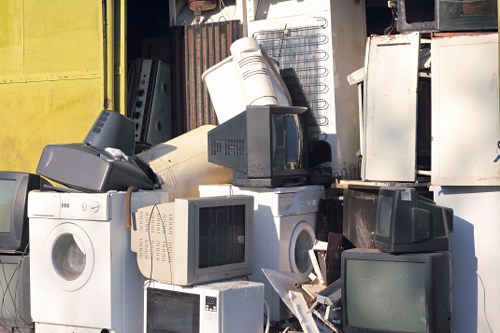
Our teams follow strict segregation protocols to separate recyclable materials, general household waste, bulky items and potential hazardous waste. Electrical items (WEEE), batteries, solvents and asbestos-suspected materials are identified and isolated for specialist handling. All staff are trained to recognise items that require referral to specialist contractors. Consistent labelling and secure containment reduce the risk of exposure and accidental mixing of incompatible wastes.Manual handling procedures emphasise correct lifting techniques, the use of mechanical aids such as trolleys and sack trucks, and coordinated team lifts for heavy or awkward items. Routes are pre-planned to avoid obstructions and to maintain clear egress. Reporting of near-misses and hazards is encouraged to enable continuous improvement across the Stoke Newington flat clearance operations.

Emergency Procedures and Incident Management
Emergency preparedness includes first aid provision, spill response kits for hazardous liquids, and clear instructions for fire safety and evacuation. All incidents, injuries and near-misses are recorded and investigated to identify root causes and corrective actions. Where appropriate, incidents are escalated to external agencies following statutory requirements. The organisation supports affected employees with access to first aid and occupational health where needed.We maintain a programme of audits, toolbox talks and site inspections to monitor compliance. Performance indicators include incident frequency, completion of risk assessments, PPE compliance and training currency. Management reviews of health and safety performance are carried out periodically to align resources and priorities for the rubbish removal service area. Mental wellbeing and workplace stress are considered part of the health and safety remit, with supervisors trained to recognise and respond to concerns sensitively.